
SUMMITFEED / HOSPITAL GEO
Hospital GEO: How Can Your Hospital Appear in AI Recommendations?
Hospital GEO should help patients find your hospital by making its strengths part of the AI recommendation.
SUMMITFEED connects evidence and sources so recommendations explain why a patient might choose the hospital, then connects those answers to care information and inquiries.
Contents
- How does a hospital name mention differ from a recommendation that explains its strengths?
- How can AI explain a hospital’s strengths as reasons to recommend it?
- Why should hospitals work on SEO alongside AI recommendations?
- What evidence supports medical expertise and a hospital’s strengths?
- How should hospital content be divided by specialty?
- What do we measure in ChatGPT, Gemini, Perplexity and Claude?
- SUMMITFEED runs hospital GEO in eight steps
Key takeaways
How often AI recommends a hospital matters, but the ultimate goal is to bring in patients. SUMMITFEED connects evidence for the hospital’s strengths and manages SEO and GEO together, so AI can explain those strengths as reasons to recommend the hospital and connect patients to care information and inquiries.
01How does a hospital name mention differ from a recommendation that explains its strengths?
Both answers recommend a hospital, but they describe it differently. One confirms a registered specialty; the other explains why the hospital fits a patient who wants to discuss surgery, prosthetics and follow-up care together.
An answer focused on registration information
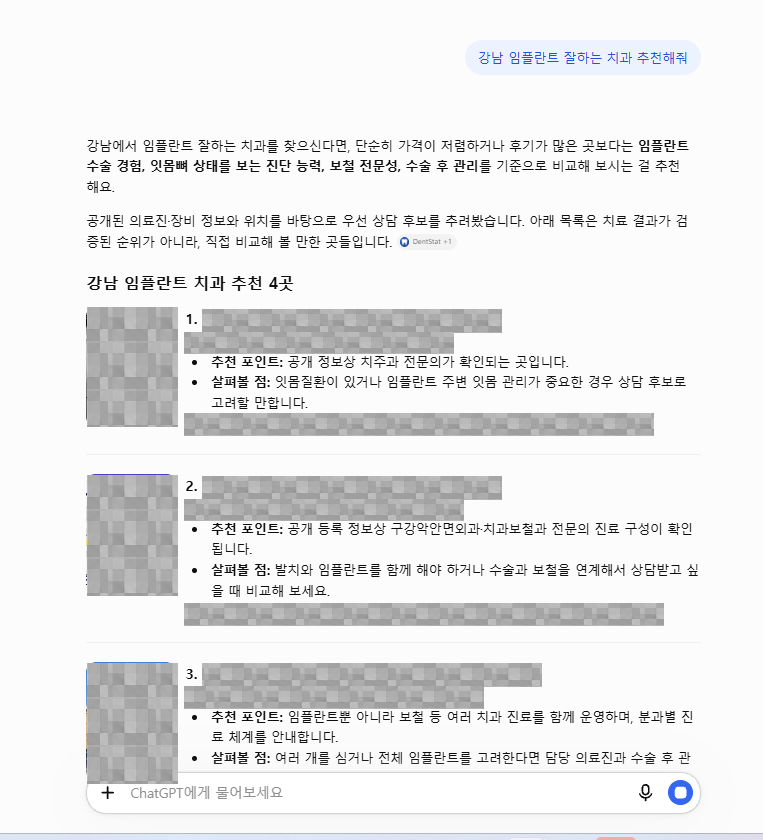
Original Korean answer
공개 정보상 치주과 전문의가 확인되는 곳입니다.
English translationPublic information confirms that this clinic has a periodontist.
What the answer explainsIt communicates the registered specialist information, but gives only a brief explanation of why a patient might choose the clinic.
An answer that highlights the hospital’s strengths
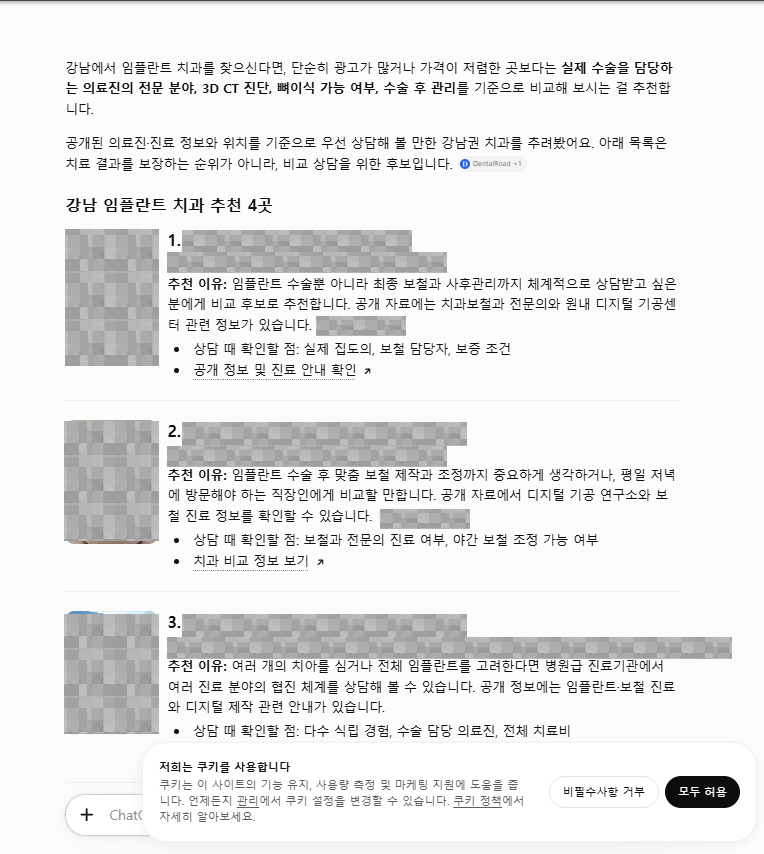
Original Korean answer
임플란트 수술뿐 아니라 최종 보철과 사후관리까지 체계적으로 상담받고 싶은 분에게 비교 후보로 추천합니다. 공개 자료에는 치과보철과 전문의와 원내 디지털 기공센터 관련 정보가 있습니다.
English translationRecommended as a comparison candidate for someone who wants a structured consultation covering implant surgery, final prosthetics and follow-up care. Public materials include information about a prosthodontist and an in-house digital dental laboratory.
What the answer explainsIt goes beyond the staff listing to connect surgery, prosthetics and follow-up care, explaining which patients it fits and why.
02How can AI explain a hospital’s strengths as reasons to recommend it?
Go beyond stating that the hospital has a prosthodontist and explain how it connects surgery, prosthetics and follow-up care when the care process is described in detail.
SUMMITFEED connects the hospital’s actual care methods and medical staff information to supporting evidence, then repeatedly measures how those strengths appear in AI answers.
03Why should hospitals work on SEO alongside AI recommendations?
When discussing hospital GEO, we often encounter websites built around one long image, from staff introductions through treatment descriptions. Patients can see the information, but little of it exists as text on the page.
Before changing detailed search settings, move the key explanations from the image into the page text. Start with information patients need when choosing a hospital, such as the clinician responsible, the care process and follow-up care.
Essential website checks
| Item | What the hospital should check |
|---|---|
| Image-only content | Are treatment descriptions only inside images, or can they also be read as text? |
| robots.txt | Are search services blocked from reading treatment pages? |
| Page title | Does the search result title identify the hospital and the care offered? |
SEO helps patients find a hospital and its treatment pages in search. It works alongside GEO so a patient who searches after an AI recommendation, or follows a source link, can read about the clinicians and care before making an inquiry.
04What evidence supports medical expertise and a hospital’s strengths?
First explain who provides each type of care, then link to evidence that supports that description. Rather than repeating the word “specialist,” describe current affiliation, qualifications, assigned treatments, consultation and follow-up care.
Medical information is a YMYL subject because it affects health and safety. Make authorship, expertise and evidence clear in line with Google’s E-E-A-T guidance, and state only the parts actually written or reviewed by medical professionals. Google’s content guidance
Add external evidence to the website’s explanations: institutional and professional association profiles that identify the clinician’s actual affiliation and activities, relevant presentations and papers, and public interviews. The useful material explains what care the hospital provides and why it may be considered, rather than simply repeating its name.
Connect clinicians to their care
Connect each clinician’s name, specialty, current branch and assigned care. Do not combine staff or careers from different branches.
Cross-check external sources
Compare whether institutions, professional associations, presentations and interviews describe the same clinicians and fields of care.
Two reviews of medical-law wording
SUMMITFEED/Clinic GEO reviews medical-law-related wording twice, at the draft and pre-publication stages. Clinical review and legally required advertising review are separate.
05How should hospital content be divided by specialty?
Divide it by the care and conditions patients ask about. Instead of publishing the same article with a different hospital name, give each question its own answer. These are examples for content planning; the links lead to existing insights for each field.
| Specialty | Questions and information to cover |
|---|---|
| Dermatology | Separate questions about Ultherapy, Rejuran and lifting recommendations. Explain the clinician responsible, treatment planning and follow-up. |
| Dentistry | Separate implant, orthodontic and wisdom-tooth extraction questions. Explain who performs surgery and prosthetics, the treatment stages and included costs. |
| Plastic surgery | Separate consultations about facelifts, revision eye surgery and rhinoplasty. Connect the surgeon responsible for each operation with anesthesia and recovery guidance. |
| Ophthalmology | Separate glaucoma, SMILE LASIK and cataract questions. Distinguish examinations and clinicians for disease care and vision correction. |
| Orthopedics | Separate herniated-disc, knee-pain and shoulder-rehabilitation questions. Explain the scope of actual care, examinations and rehabilitation. |
| Korean medicine | Separate consultations about herbal weight-loss medicine, care after traffic accidents and indigestion. Explain the practitioner, consultation and care after a prescription. |
06What do we measure in ChatGPT, Gemini, Perplexity and Claude?
SUMMITFEED measures with AIGEO, then cross-checks in incognito mode.
| AI | What to check in the answer |
|---|---|
| ChatGPT | Why the hospital was recommended and which page supported that explanation |
| Gemini | The hospital’s strengths and recommendation criteria, and the distinction between evidence and related links |
| Perplexity | Whether the cited page explains the strengths of that hospital and its care |
| Claude | Whether web search was used, why the hospital was recommended and which sources were linked |
Hospital-name mentions, source citations and explanations of strengths are reported separately. Treatment-page visits, inquiry clicks and completed consultations are then assessed as related measures; traffic with an unknown source is not arbitrarily counted as AI performance. How SUMMITFEED measures four AI platforms
07SUMMITFEED runs hospital GEO in eight steps
One SUMMITFEED team handles question design, website structuring, content creation and distribution, and remeasurement. Beyond counting mentions, it designs a path in which the hospital’s strengths are explained as reasons for recommendation and lead to inquiries.
01Design target questionsChoose questions based on the care offered and patient situations. | 02Measure AI visibilityAfter the initial AIGEO measurement, cross-check in incognito mode. | 03Audit the websiteCheck page text, robots.txt, indexing and canonical addresses. | 04Analyze recommendations and sourcesCompare reasons other hospitals are recommended and the sources cited. |
05Create answer contentWrite content for each question and review medical-law-related wording. | 06Structure informationConnect the hospital, clinicians, care and articles with internal links and schema. | 07Distribute external contentReview facts and wording again and edit for each channel. | 08Remeasure and improveCompare recommendation reasons, sources and inquiry paths for the same questions. |
Hospital GEO: frequently asked questions
How does hospital GEO lead to patient visits?
Not every question asked in AI or every traffic path is visible. Some patients describe their situation to AI and ask for a hospital recommendation instead of visiting several sites. A recommendation that explains strengths such as the clinicians and care methods gives patients reasons to choose and trust the hospital before a visit. SUMMITFEED designs that recommendation to connect to care information and consultations.
Is GEO working if AI mentions the hospital by name?
Check the recommendation reason, sources and subsequent traffic as well. A name mention is an initial indicator; which patients were recommended the hospital and why, and whether they made inquiries, are measured separately.
Will AI recommend a hospital if robots.txt allows access?
That setting controls crawler access. Also check the page content, indexing, external evidence and the reasons given in actual AI answers.
Is adding alt text to an image enough?
Medical staff, treatment processes, costs and precautions should also be written as page text. Alt text describes what the image itself shows.
How many articles should each specialty have?
Decide after comparing patient questions with existing content. Separate questions with different purposes, such as implant selection, recovery and cost, instead of repeating the same information with different wording.
What results does SUMMITFEED report?
It reports hospital mentions, cited URLs and recommendation reasons by question across four AI platforms. Website traffic and inquiries are assessed as separate, related metrics.
Help AI recommend your hospital’s strengths
Explaining why patients should choose the hospital comes before producing a large volume of content. SUMMITFEED improves website treatment information and external evidence, then measures how AI answers describe the hospital’s strengths. It designs SEO traffic and AI recommendations to connect with care information and inquiries.